
Sacraments & Sacramental Rites
At Trinity Episcopal Church, we understand the sacraments as outward and visible signs of inward and spiritual grace, given by God to draw us more deeply into the life of Christ. Through word, water, bread, wine, prayer, and community, God meets us, forms us, and sends us into the world.
The Episcopal Church recognizes two primary sacraments given by Christ — Baptism and Holy Eucharist — and five sacramental rites that mark important moments in the life of faith.
The Two Great Sacraments of the Gospel
Holy Baptism
Baptism is the sacrament by which we are incorporated into the Body of Christ and welcomed into the Church. Through water and the Holy Spirit, we are claimed as God’s beloved and invited into a lifelong journey of faith.
Baptism is available for all ages — infants, children, youth, and adults. When infants or young children are baptized, their parents and godparents make promises on their behalf, committing to raise them in the Christian faith, to pray for them, and to help them grow in the life of the Church, with God’s help and the support of the community.
As children mature and are able to make their own profession of faith, they are invited to Confirmation, in which they publicly affirm the baptismal promises made on their behalf and take greater responsibility for their life in Christ.
Baptism is always celebrated within the worshiping community, because faith is never meant to be lived alone.
Thinking about baptism?
Whether for yourself or your child, we invite you to reach out to the clergy to begin a conversation. We’d be honored to walk with you.
Holy Eucharist (Communion)
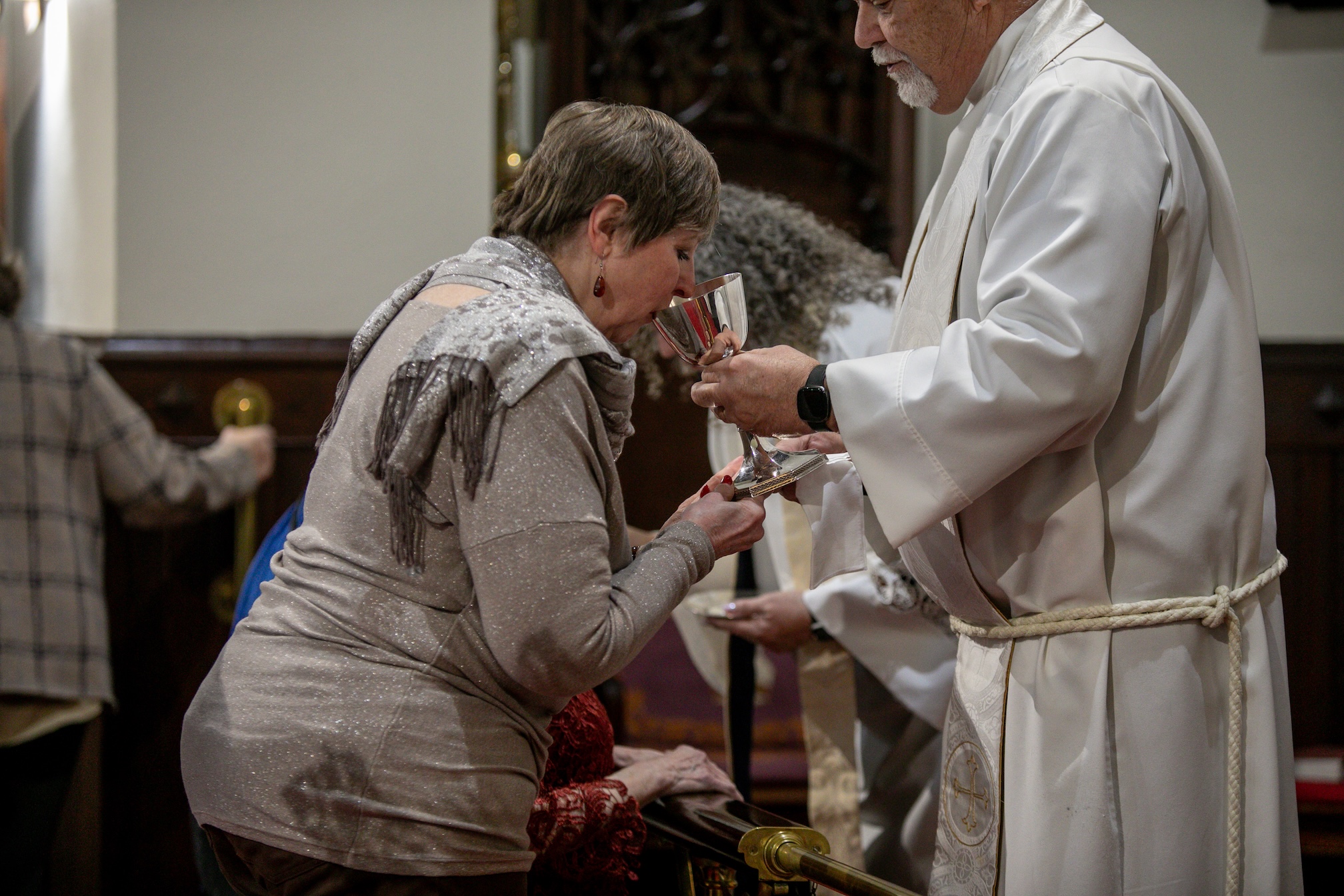
The Eucharist — also called Holy Communion — is the central act of Christian worship. In the bread and the wine, we receive the real presence of Christ, nourished by grace and strengthened for lives of love and service.
Within the Episcopal Church, there is a breadth of faithful understanding about how Christ is present in the Eucharist. Rather than insisting on a single explanation, we hold together reverence, mystery, and trust. Some Episcopalians understand this presence in ways similar to transubstantiation; others use different language to describe the mystery. What unites us is not a precise theory, but the shared conviction that Christ truly meets us at the table and that this sacrament is a means of grace.
At Trinity, Communion is offered in the form of bread (a small wafer, often called a host) and wine. The use of real wine is an ancient Christian practice and a sign of the fullness and joy of God’s gift to us. Those who do not wish to receive wine may receive the bread alone, which is considered a full Communion.
The bread we use is simple and plain by design. Its purpose is not necessarily to delight the senses, but to point us beyond itself — reminding us that in the Eucharist, it is Christ who feeds us, not the bread alone. The simplicity of the host emphasizes that this meal is a gift of grace, received rather than produced, and shared equally by all.
All baptized Christians are welcome to receive Communion in the Episcopal Church. At Trinity, children are welcomed to the table as soon as they are able to come forward and receive the bread, with the guidance and permission of their parents or caregivers.
New to Communion in the Episcopal Church?
If you have questions about how Communion is shared, what to expect, or how to participate, please know that you are always welcome to ask — or simply to receive a blessing instead.
The Sacramental Rites
In addition to Baptism and Eucharist, the Church recognizes five sacramental rites. These rites are not required for all people, but they are sacred ways the Church offers God’s blessing and presence at significant moments in life.
Confirmation is the rite in which a person makes a mature, public affirmation of faith, often following a period of study and reflection. Generally, confirmation is offered to those who are fourteen years and older. It is celebrated by the bishop and marks a deepening commitment to life in Christ and the Church.
Interested in Confirmation?
Let us know — preparation is offered as needed, often in conjunction with a bishop’s visit.
Reception
Reception is for those who have been confirmed in certain other Christian traditions and are formally received into the Episcopal Church by the bishop.
Coming from another denomination?
We’d love to help you discern whether Reception is the right next step.
This rite offers an opportunity to renew one’s baptismal promises, often during a time of transition, renewal, or spiritual growth.
At a crossroads in life or faith?
Reaffirmation can be a meaningful way to mark a new season.
Marriage is the sacramental rite in which two people enter into a lifelong covenant, seeking God’s blessing and grace to love one another faithfully. In Christian marriage, the couple promises mutual love and support, grounded in prayer and the presence of God.
The Episcopal Church affirms that marriage is a sacred vocation and recognizes marriage equality at the churchwide level. Within the Episcopal Diocese of Texas, parishes are encouraged to engage this teaching through prayerful discernment, conversation, and pastoral care, honoring both conscience and community.
At Trinity, we approach marriage as a pastoral journey, not simply an event. We are committed to walking with couples thoughtfully and prayerfully, in conversation with our clergy and leadership, as we seek to be faithful to God’s call and the life of our parish.
Thinking about getting married at Trinity?
We invite you to contact the clergy to begin a conversation. We would be honored to listen, discern, and walk with you.
Sometimes called confession, this sacramental rite offers a private and prayerful space to confess sins, receive absolution, and experience God’s mercy and forgiveness.
In the Episcopal Church, confession takes more than one form. During the Eucharist and other liturgies, we make a corporate confession, acknowledging our sin and receiving God’s forgiveness together as a community. This shared act reminds us that we are all in need of grace and that reconciliation is part of our common life.
Private confession — the Reconciliation of a Penitent — is similar in purpose but different in setting. It is a one-on-one conversation with a priest, focused on personal reflection, prayer, and the assurance of God’s forgiveness. Some people find this form of confession helpful during times of spiritual struggle, transition, or when seeking healing and clarity.
At the same time, the Episcopal Church affirms that we may always confess our sins directly to God and receive forgiveness through prayer and repentance. God’s mercy does not depend on a mediator. Private confession is offered as a gift and a tool for healing — never as a requirement.
This is often summed up in a traditional Episcopal phrase: “All may; some should; none must.”Marriage is the sacramental rite in which two people enter into a lifelong covenant, seeking God’s blessing and grace to love one another
Seeking prayer, forgiveness, or a fresh start?
This sacrament is always available — simply reach out to the clergy.
Unction of the Sick is a rite of prayer and anointing offered to those who are ill, facing surgery, recovering from injury, or in need of spiritual or emotional healing.
The word unction means “anointing.” In this rite, the priest prays and may anoint the person with oil as a sign of God’s healing presence, strength, and peace.
Going in for surgery or recovering from illness?
Please let us know if you would like prayers or Unction of the Sick. This sacrament is offered in hospitals, homes, or at church.
The Burial of the Dead is the Church’s rite for commending the departed to God and comforting those who mourn. Rooted in the hope of the resurrection, this service proclaims that life is changed, not ended, and that nothing — not even death — can separate us from the love of God in Christ Jesus.
The service may take place in the church, at a funeral home, at the graveside, or in another appropriate setting. It includes Scripture, prayer, and the Church’s ancient words of hope, offering both honesty about grief and confidence in God’s promises.
Trinity is honored to serve families in times of loss, whether or not the person who has died was a member of this parish. We are glad to walk with families of any faith tradition — or none — and to help shape a service that offers dignity, care, and prayer in a moment of deep vulnerability.
Planning a funeral or memorial service?
Whether the death has just occurred or plans are being made in advance, the clergy are available to listen, pray, and help guide you through next steps.
A Living, Sacramental Faith
At Trinity, the sacraments are not simply ceremonies — they are part of a larger rhythm of worship, formation, and mission. They remind us that God’s grace meets us in every season of life and sends us into the world renewed.
If you have questions or would like to explore any of these sacraments or rites, we invite you to reach out to a member of the clergy. We would be honored to walk with you.
 Trinity Episcopal Church